


Both S1P and S3 safety footwear have protective toe caps and penetration-resistant underfoot protection. The main difference is that S3 additionally requires an upper that meets water penetration and absorption requirements and a cleated outsole. That does not make S3 boots fully waterproof. Under the updated EN ISO 20345:2022 standard you will also see S3L and S3S, which identify different types of non-metallic penetration-resistant inserts and test methods.
If you're buying safety boots for work, ratings such as S1P, S3, S3L and S3S can look like a confusing string of letters. This is a specification-based guide, not independent boot testing. Workplace footwear must be selected for the hazards identified by a competent risk assessment.
What Do S1P and S3 Mean on Safety Boots?
The safety categories come from EN ISO 20345, the standard for safety footwear with protective toe caps. The basic standard covers toe-cap resistance to a 200-joule impact and a specified compression test; the category and any extra letter codes identify more properties.
- S1P: an S1-level shoe or boot with tested penetration resistance underfoot. S1 requirements include an enclosed heel, antistatic properties and heel energy absorption.
- S3: adds the upper water penetration and absorption requirement and a cleated outsole, alongside penetration protection. Under the 2022 classification, unsuffixed S3 uses the P metallic insert classification.
- S3L and S3S: S3-type categories with PL or PS non-metallic penetration-resistant inserts.
Not every S1P shoe is light, and not every S3 boot is heavy. Comfort, weight and fit depend on the actual model, not the rating alone.
S1P vs S3 Safety Boots: Side-by-Side Comparison
| Feature | S1P | S3 (EN ISO 20345:2022) |
|---|---|---|
| Protective toe cap | Required | Required |
| Enclosed heel | Required | Required |
| Antistatic properties | Required | Required |
| Heel energy absorption | Required | Required |
| Penetration-resistant insert | Required | Required |
| Upper water penetration and absorption (WPA) | Not part of category requirements | Required |
| Cleated outsole | Not part of category requirements | Required |
| Whole-footwear water resistance (WR) | Not automatically included | Not automatically included |
An individual boot may have additional certified features beyond its base category. Check the full set of symbols on the footwear and its documentation instead of relying on the letters S1P or S3 alone.
S1P: Often suitable for dry indoor work
S1P is common where a risk assessment requires protection from falling objects and puncture hazards, but upper water penetration resistance is not required. That could include some dry workshop, warehousing or indoor fit-out environments, depending on site rules. It is not appropriate for every warehouse or workshop: slip, chemical, electrical or heat hazards may need extra protection.
S3: Adds protection against water penetrating the upper
S3 brings in WPA, a test of how the upper resists water penetration and absorption, plus a cleated outsole. These may suit damp ground or outdoor work. But a water-resistant upper is not a whole-footwear water-resistance rating: water can still enter through other parts of the boot outside tested conditions.
If you need protection against water entering the whole boot, look for an appropriate WR marking or a category such as S7 under the 2022 standard, rather than assuming S3 is waterproof.
What Are S3L and S3S Safety Boots?
The 2022 update to EN ISO 20345 made penetration-resistance categories more specific. Instead of treating every underfoot insert as equivalent, the labels identify the material type and test method.
Metallic insert (P test). Also: upper WPA and cleated sole.
Tested with a 4.5mm nail. Also: upper WPA and cleated sole.
Tested with a 3.0mm nail. Also: upper WPA and cleated sole.
These ratings identify different test methods, not a simple best-to-worst ranking. The right option depends on your risk assessment and the manufacturer's certified performance information. You may also see S1PL and S1PS on newer footwear, which apply the same insert distinctions to the S1 family.
Why do some boots still say EN ISO 20345:2011?
Retailers may sell products labelled under the older 2011 edition as well as newer 2022 classifications. The newer system adds SR for an extra slip-resistance test and new insert distinctions. Don't read an older S3 label exactly like a new S3L or S3S: check the standard year, label and manufacturer documentation.
Are S3 Safety Boots Waterproof?
Not necessarily. The WPA marking relates to water penetration and absorption of the upper. WR refers to tested water resistance of the whole footwear. Under EN ISO 20345:2022, S7, S7L and S7S build on S3-type protection with whole-footwear water resistance. For consistently wet work, check the full specification and your workplace assessment rather than relying only on the S3 label.
Steel toe or composite toe?
An S1P or S3 rating does not mean the toe cap is steel. Certified steel, aluminium, composite or other toe caps can all meet the same toe-protection tests; weight, fit and design vary. Also note that antistatic footwear is not electrically insulating footwear: electrical work needs different protective equipment and procedures.
How to Choose Safety Boots for Your Job
Start with the work and the specific hazards, not a boot's appearance or a higher-looking rating. The UK Health and Safety Executive lists risks including impact, penetration, slips, temperature and chemical exposure.
- Impact + compressionCheck certified toe protection for the task.
- Sharp objects underfootLook for a suitable penetration-resistant insert.
- Water + wet surfacesWPA is not the same as whole-boot WR.
- Slips + specific risksCheck SR, FO, HRO or other relevant markings.
Check your workplace's requirements
Many employers or sites specify minimum categories and extra markings. A protective toe cap alone may not be enough where nails, sharp debris, slippery floors or specialist hazards are present.
Understand additional protection codes
- SR: additional slip-resistance test under the newer standard (older boots show SRA, SRB or SRC instead).
- FO: outsole resistance to fuel oil.
- HRO: outsole resistance to hot contact.
- CI / HI: cold or heat insulation of the sole complex.
- WR: whole-footwear resistance to water.
- M: metatarsal protection.
Not every boot needs every code. Choose the features your work requires and check the exact marked specification.
Check fit, model and standard year
A high rating is of little use if the boots don't fit. Allow toe space, secure heel retention and room for your work socks, and check sizing and returns policy. Similar-looking products can carry different codes across versions or sizes, so confirm the model, UK size, printed rating and standard year.
Safety Boots to Consider at DBR Tools
The examples below show how ratings and features differ. They are not rankings from independent testing. Each size is often a separate listing with limited stock, so confirm your size and the required rating before ordering.
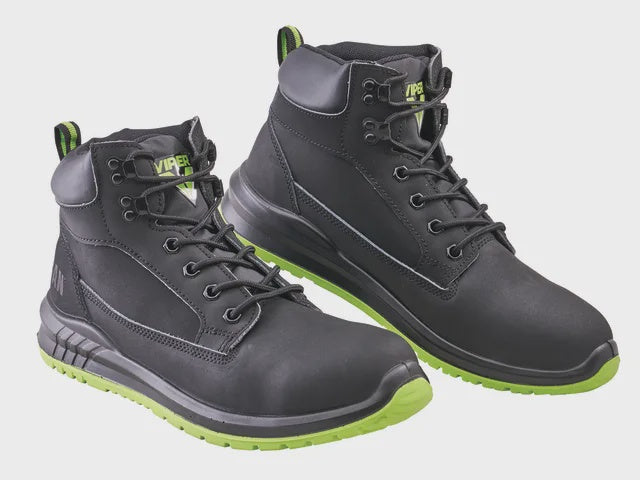
Scan Viper SBP Safety Boots
Full grain leather, 200J steel toe cap and penetration-resistant steel midsole. Listed as SBP with an SRC sole, not S1P or S3: compare the label against your requirement. Sizes are separate listings.
View at DBR Tools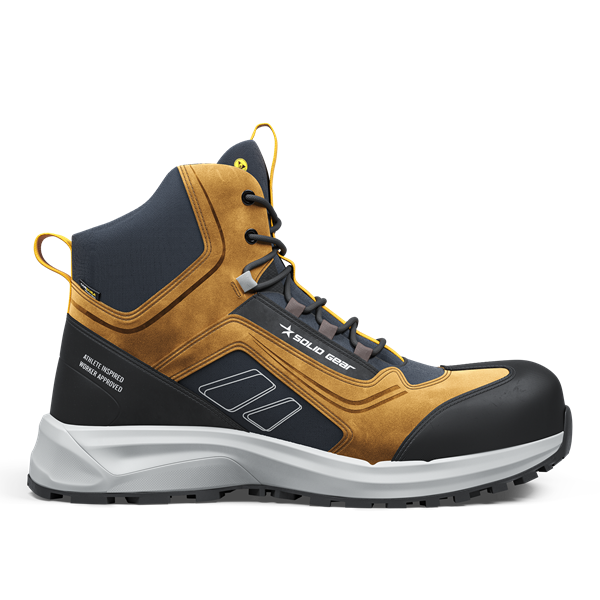
Solid Gear Adapt Mid (S3L)
Listed as EN ISO 20345:2022 S3L, SR, HRO and FO. Fibreglass toe cap, soft non-metallic penetration protection, nubuck/CORDURA upper. Size 41 listing; limited stock.
View at DBR Tools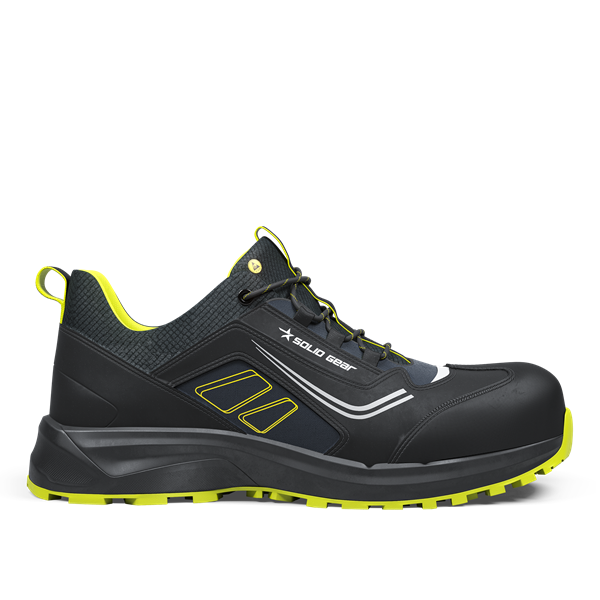
Solid Gear Adapt Low (S3L)
Lower-cut S3L, SR, HRO and FO option with a fibreglass toe cap, soft nail protection and wide fit. Not for tasks needing ankle protection. Size 43 listing; limited stock.
View at DBR ToolsBrowse the Safety & Workwear collection to compare styles and sizes.
Common Safety Boot Buying Mistakes
- Assuming S3 means fully waterproof: it doesn't automatically provide whole-footwear WR protection.
- Choosing solely by S1P or S3: extra hazards may need further ratings.
- Treating SR and SRC as identical: they belong to different versions of the standard.
- Assuming a composite toe is required for S3L: the suffix describes underfoot penetration resistance, not toe-cap material.
- Ignoring the specific size and model listing: similar products may have different markings or availability.
Frequently Asked Questions
Is S3 better than S1P?
S3 adds upper water penetration and absorption requirements and a cleated outsole. That may suit some damp or outdoor environments, but the better boot is the one that meets your workplace risk assessment and fits properly.
Are S1P safety boots waterproof?
Not by virtue of the S1P classification. S1P includes toe and underfoot protection but not the upper water properties that form part of S3. Any extra water resistance must be confirmed separately.
Does S3 mean steel toe caps?
No. A model may use a compliant steel or non-metallic toe cap. Under the 2022 standard, the P in unsuffixed S3 refers to the underfoot metallic insert, not the toe-cap material.
What does S3S mean?
S3S describes S3-type footwear with a non-metallic PS penetration-resistant insert tested with a 3.0mm nail, plus the S3 upper and outsole requirements.
What's the difference between S3 and S7?
Under EN ISO 20345:2022, S7 builds on S3-type requirements with whole-footwear water resistance (WR). S7L and S7S are the non-metallic insert variants.
Can I wear S1P safety boots on a building site?
Only if the site's risk assessment and rules permit that specific footwear. Terrain, debris, water and slip risks vary, so the required category is not universal.
Final Verdict: S1P or S3 Safety Boots?
For suitable dry work environments needing toe and penetration resistance, S1P may meet the need. If upper water penetration resistance and a cleated outsole are required, look at S3, or the newer S3L/S3S variants where the insert category matters. Don't mistake S3 for a promise that the entire boot is waterproof. Check the full marking, standard year, correct size and workplace requirements before buying.
Check current stock, sizes and markings before you buy.
Shop safety & workwear