


Choose a tape measure for short, direct measurements and transferring marks onto a surface. A laser distance measure is often more convenient across rooms, for wall-to-wall distances and estimating areas, provided there's a suitable target surface. For many tradespeople, owning both beats treating one as a complete replacement for the other.
From a shelf width to a room for flooring, accurate measurements matter, but it's hard to judge whether a retractable tape or a digital laser meter is the better investment. This guide explains how each measures, where each has limits and which features matter. It's based on published specifications and intended uses, not hands-on testing.
Tape Measure vs Laser Distance Measure: The Main Differences
Tape measure
Direct contact with the object
Useful for short, marked spans. No battery needed. Accuracy class and blade condition matter.
Laser distance meter
Digital reading to a target
Useful for room measurements, and some models calculate area. Target surface and conditions matter.
A tape measure shows the distance between two points on a marked blade, which is handy when the line follows a material or you need to mark timber or trim directly. A laser distance measure calculates the distance from the device to a suitable target optically, shows it digitally, and on some models calculates area or volume.
| Consideration | Retractable tape | Laser distance measure |
|---|---|---|
| Best suited to | Short measurements, direct marks, individual components | Room dimensions, wall-to-wall distances, estimating spaces |
| Physical contact | Normally touches the item measured | Needs a suitable target surface |
| Range | Limited by tape length and blade support | Model-specific published optical range |
| Accuracy | Depends on accuracy class, condition and technique | Depends on model tolerance, target and conditions |
| Outdoors | Often practical in bright conditions | Bright sunlight and reflective or dark surfaces can make readings harder |
| Calculations | Typically manual | Area, volume and memory on selected models |
| Power | No batteries | Batteries or charging |
Neither type is inherently accurate in every situation. The task geometry, tolerance and how the instrument is referenced all matter.
When Is a Tape Measure the Better Choice?
Individual materials: a retractable tape suits short spans such as panels, shelves and trim, with the scale right beside the material. No clear laser target: a tape depends less on a target wall and copes with open ends and awkward shapes. Bright outdoor light: sunlight can make a laser spot hard to see and cut its range, depending on model and surface, though long unsupported tape spans and wind bring their own problems. Simplicity: a tape needs no display or battery, and for basic DIY a good 5m or 8m tape may be all you need.
When Is a Laser Distance Measure Worth Buying?
Rooms and property work: straight distances across a large room without stretching a long tape. Area and volume: many models calculate rectangular area and volume for preliminary flooring or decorating estimates, though complex spaces need careful breakdowns. Records: some models keep recent results in memory, which is model-specific, not universal. Longer spans: often easier than a short tape, but check the minimum and maximum range and whether the target material and lighting suit optical measurement.
Which Is More Accurate: A Tape or a Laser?
It depends on the specific tool and conditions, not the category. Stanley identifies its FatMax BladeArmor 0-33-720 as a Class II tape, with a 5m blade and 32mm blade width. The Grettz GLD70 is published with a 0.05 to 70m range and a typical accuracy of ±2mm, the maker's quoted specification under its stated conditions, not a promise for every material or full sunlight.
A tape's accuracy class isn't directly comparable to a laser meter's ±mm tolerance. For critical work, follow the project requirements and the maker's verification guidance.
Key Features to Compare Before Buying
- Measuring rangeTape length or laser rated span. Longer is not always more useful.
- AccuracyClass II versus a stated laser tolerance. The ratings are not interchangeable.
- Reference pointTape hook or device front or rear. Know where the measurement starts.
- ConditionsBlade handling, surface and light. Read the maker's limitations.
Length or range: a 5m tape is a handy general size and 8m gives more reach, but choose by actual reach needed. A laser's headline 40m, 50m or 70m is a maximum stated range, not proof it works on every surface. Readability: clear metric markings, double-sided blades and easy-to-read displays help in low light or at awkward heights. Reference point: a tape has an end hook, while a laser may measure from the front or rear of its housing, a common cause of mismatched readings. Tape construction: compare blade width, coating, hook, lock and housing feel. A wider blade can give more unsupported reach, but isn't an accuracy rating. Laser functions: not every meter has Bluetooth, angle sensing, area calculation or an IP rating. Task fit: a distance meter measures distance. It's not a cross-line laser level and can't replace a tape for every mark-out job.
Measuring Tools at DBR Tools
These show different buying priorities. Stock is limited, so check availability and exact variants.
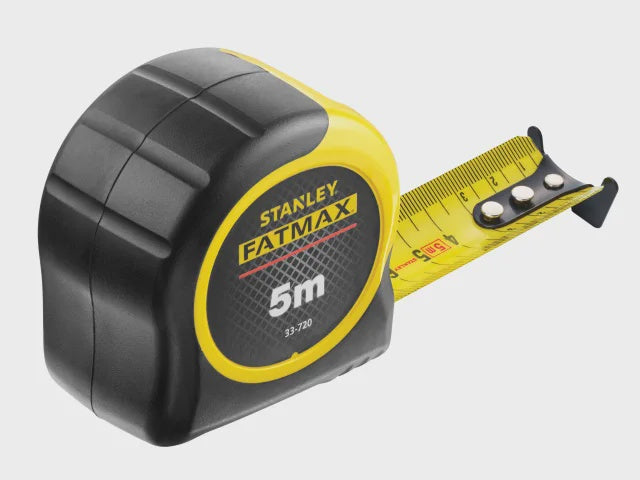
Stanley 0-33-720 FatMax BladeArmor 5m
5m metric tape with a 32mm wide blade, Mylar-wrapped coating and a multi-function hook. Stanley specifies Class II. Good for close-up site work.
View at DBR Tools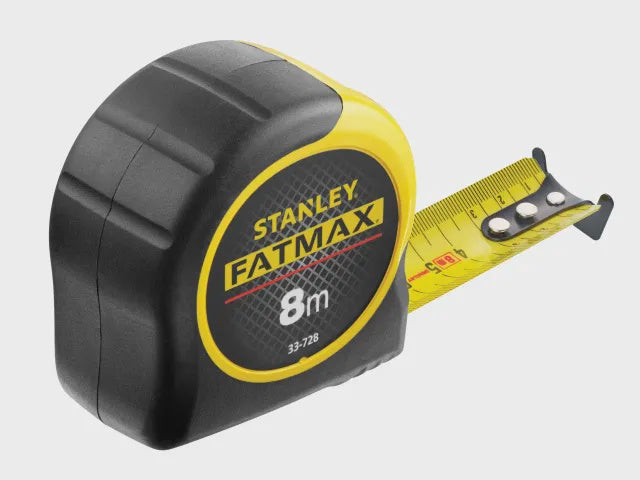
Stanley 0-33-728 FatMax BladeArmor 8m
The same BladeArmor design in 8m metric, 32mm wide, for longer physical reach.
View at DBR Tools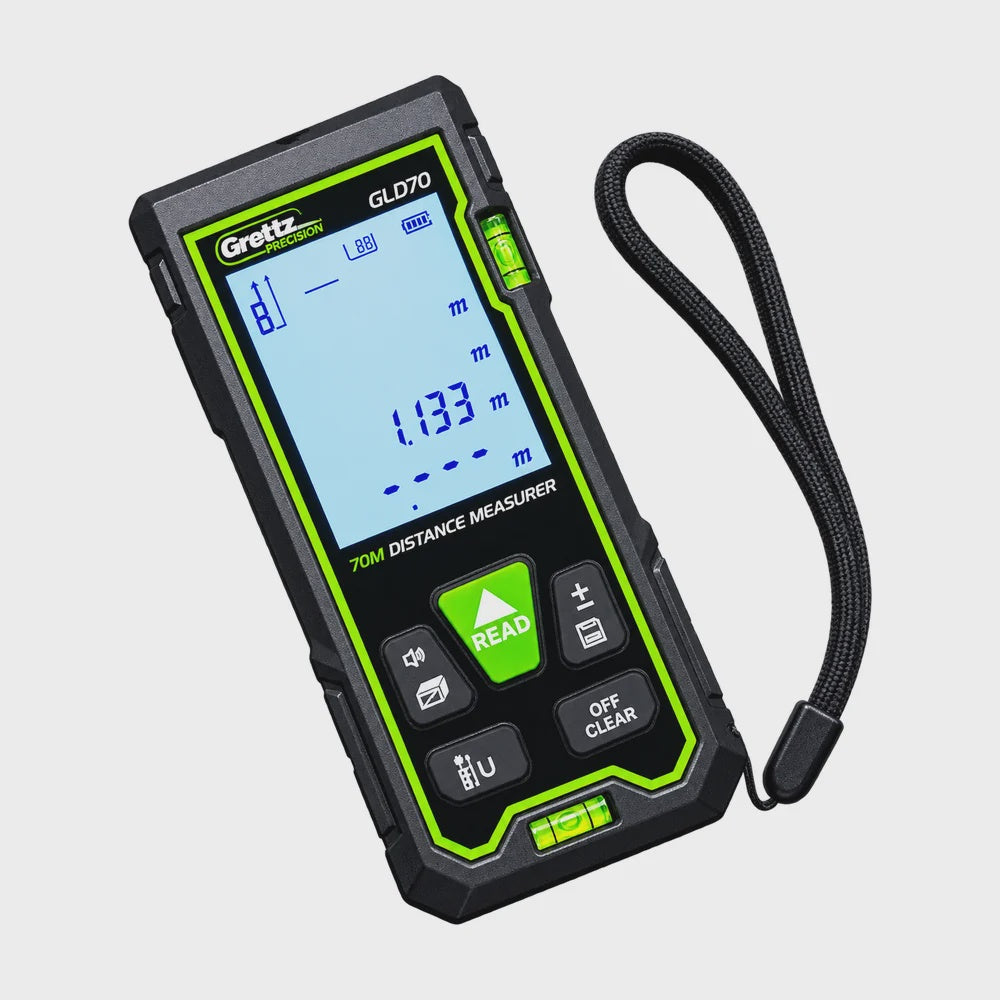
Grettz GLD70 Laser Distance Measurer 70m
70m range, accurate to 2mm per the maker, with distance, area, volume and Pythagoras modes. Runs on 2 x AAA batteries, wrist strap included.
View at DBR ToolsWhich Tool Should You Choose for Your Work?
| Type of task | Starting point | Reason |
|---|---|---|
| Cabinet, trim or furniture | Tape measure | Direct contact and easy mark transfer |
| Room dimensions or flooring estimates | Laser distance measure | Efficient straight-line room measurements |
| Mixed DIY and trade work | Both | Complementary functions |
| Bright outdoor measuring | Tape; verify laser suitability | Optical performance depends on conditions |
If you're buying one tool for everyday short tasks, start with a well-made tape. If you frequently measure whole rooms, a laser distance measure may become a valuable second tool.
Common Buying Mistakes
- Assuming a longer range means better accuracy: it doesn't, and may not suit small rooms.
- Treating all lasers as outdoor-ready: reflectivity, lighting and the model's specification matter.
- Ignoring the reference point: front versus rear readings can throw results out.
- Assuming a wide blade guarantees precision: width helps handling, not accuracy.
- Confusing a distance meter with a laser level.
- Buying on price or one spec alone: think about your usual work and conditions.
Laser safety. Use laser measuring devices as the maker's safety guidance says. Never direct the beam at anyone's eyes or stare into it, and don't assume a reflective or transparent surface is a suitable target. A laser reading doesn't establish structural suitability, safe clearances or the position of concealed services.
Frequently Asked Questions
Is a laser measure better than a tape measure?
For some tasks, especially longer straight-line measurements between suitable surfaces. A tape remains more versatile for direct contact, short components and transferring marks.
Are laser distance measures accurate?
Professional models publish tolerances, but real results depend on the device, target, distance and conditions. Grettz, for example, quotes ±2mm for the GLD70 under its published conditions.
Can a laser distance measure be used outside?
Some can, but strong sunlight, target reflectivity and the model's rated capabilities all matter. Check the exact model's outdoor guidance before using it on exposed sites.
Should I buy a 5m or 8m tape measure?
A 5m tape suits general close-up work; an 8m tape gives more physical reach. Choose by the spans you typically measure and how easily the tape handles.
Is a laser measure the same as a laser level?
No. A distance measure reports distances; a laser level projects a line or plane for alignment. Some advanced tools combine functions, but the categories aren't interchangeable.
Are magnetic tape measures more accurate?
Not automatically. The magnet is a feature of the hook and doesn't determine the tape's accuracy class.
Final Verdict: Tape Measure or Laser Measure?
For general DIY and everyday trade measuring, a quality tape is still a strong first purchase: simple, direct and ideal for parts and transferring points. A laser distance measure makes more sense for frequent room measurements, long interior spans and quick space estimates, within its stated limits. For many professionals the most practical pairing is a reliable 5m or 8m tape plus a properly specified laser meter.
Check exact specifications and stock before ordering.
Shop measuring tapes