


A tape's accuracy class is the maximum permitted graduation error under reference conditions. Class I is the tighter tolerance; Class II is the one you'll see most often on everyday tapes, and it's suitable for most general layout. It's a tolerance limit, not a prediction that your measurement will be that far out.
The class says nothing about blade width, durability or how readable the numbers are. This guide explains the tolerances, using manufacturer and EU measuring-instrument information, so you can decide whether Class I is worth chasing.
What Does a Tape-Measure Accuracy Class Mean?
Class I
Tighter tolerance
Smaller permitted error at each length. Chosen where repeated or transferred measurements matter.
Class II
Common everyday class
Wider permitted error, appropriate for most professional layout and general measuring.
The class describes the maximum permitted error in the graduations, and it grows with the length measured. A Class II tape isn't automatically 1.3mm out at 5m; that figure is the most it's allowed to be, and a real tape is often closer. Technique, an undamaged blade and the end hook matter too.
Class I vs Class II at Common Lengths
The figures below are the permitted tolerances for the graduations, excluding the end hook, which carries its own allowance. They follow the EU formula: Class I is ±(0.1 + 0.1 × L) mm and Class II is ±(0.3 + 0.2 × L) mm, with L the length in metres, rounded up to the next whole metre.
| Length measured | Class I tolerance | Class II tolerance |
|---|---|---|
| 2m | ±0.3mm | ±0.7mm |
| 5m | ±0.6mm | ±1.3mm |
| 8m | ±0.9mm | ±1.9mm |
| 10m | ±1.1mm | ±2.3mm |
A class matters most when measurements are repeated, handed between people or used for fitted components. It doesn't make a Class II tape unsuitable for ordinary measuring, and Stanley markets its Class II tapes for most professional work.
How Do You Spot the Class?
On a compliant tape, look for the class marking (a Roman numeral I or II) with metrology marks on the blade, or for "Accuracy Class II" or "EC Class II" in the specification. Don't assume Class I from a wider blade, premium coating or high price. True zero is a hook design that compensates for the hook's thickness on inside and outside measurements, so it's separate from the accuracy class.
Set by the tolerance class.
Tru-zero hooks compensate for hook thickness. Check the hook isn't bent.
Affect standout and readability, not class.
How Much Precision Do You Actually Need?
For site layout, room measuring, shelving and general checks, a durable Class II tape is often a sensible choice. Precision-critical fitting, or a dimension passed from one person to another, may justify a Class I tape or a different instrument. Two identical measurements can still differ through alignment, sag, blade temperature or the reference point, so for exacting work follow the relevant tolerances rather than relying on a tape's label.
Don't buy on class alone. The person measuring also needs readable numbers, a stable blade, a suitable length and an intact hook. For longer distances, see tape measure vs laser distance measure, and for marking out, combination square vs framing square.
What to Compare Before Buying a Tape
- LengthA 5m tape is easier to carry than an 8m or 10m, but range matters.
- WidthA wider blade can be easier to read and stand out further. It doesn't change calibration.
- ScaleMetric only, or dual metric and imperial.
- HookTru-zero or fixed, and whether it's riveted firmly.
- ProtectionCoating and case affect lifespan, not accuracy class.
Class II Tapes at DBR Tools
Both listings state their class. Stock is limited, so check before ordering.
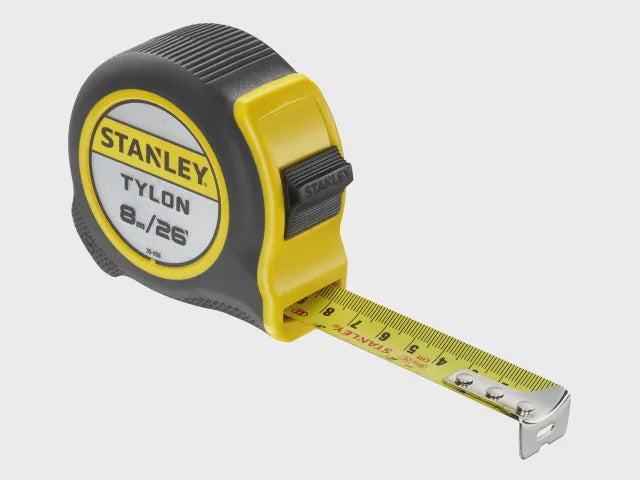
Stanley STA130656N Tylon Pocket Tape 8m, Class II
Tylon-coated blade, 25mm wide, metric and imperial, Tru-zero hook and a positive blade lock. The listing states Class II. 10 in stock.
View at DBR Tools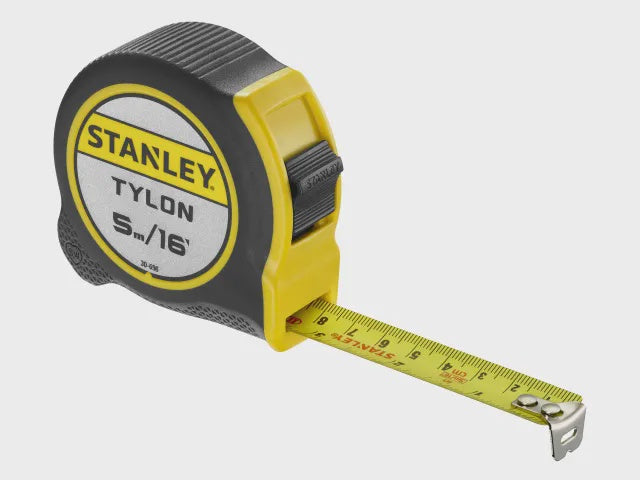
Stanley STA130696N Tylon Pocket Tape 5m, EC Class II
19mm wide blade, metric and imperial, Tru-zero hook and triple rivet construction. The listing states EC Class II. 16 in stock.
View at DBR ToolsBrowse the Measuring Tapes collection.
Tape Measure Class FAQs
Is Class I always more accurate than Class II?
Its allowed tolerance is tighter. Individual tapes still vary, so two real tapes can't be ranked without checking them.
Is Class II good enough for carpentry?
Often yes for general layout. Fine fitting, contractual tolerances and calibrated work may need more exact methods.
Does a 32mm blade mean Class I?
No. Blade width and accuracy class are separate characteristics.
What does ±1.3mm at 5m mean?
It's the maximum permitted tolerance for a Class II tape at 5m, not the error of any particular tape.
The Bottom Line
Class I has a tighter tolerance than Class II, but a clearly marked, well-made Class II tape is right for most jobs. Choose on the work, then check the class, hook and blade.
Check length, class and stock before ordering.
Shop tapes